

Walker vs. Rollator: How to Know Which Mobility Device Is Actually Right for You
By Sara Sparks, PT, DPT | Graceful Aging
One of the first things I notice when I walk into a client's home isn't the furniture or the layout.
It's the walker sitting quietly in the corner.
Sometimes it's folded up in a bedroom.
Sometimes it's tucked behind a recliner.
Sometimes it's covered with laundry.
When I ask why it isn't being used, I usually hear one of the same few answers.
"It's awkward."
"I don't really like it."
"I only use it when someone makes me."
"I think I'm okay without it."
I understand.
Mobility equipment can feel like a reminder that life has changed.
But over the years I've realized something important.
Most people don't avoid using their walker because they're stubborn.
They avoid it because it's often the wrong piece of equipment—or no one ever taught them how to use it correctly.
The right mobility device should make life easier.
If it doesn't, something probably needs to change.
There Is No "Best" Walker
One of the biggest misconceptions I hear is someone asking,
"Which is better—a walker or a rollator?"
The truth is neither one is better.
They're simply designed for different people.
The right answer depends on your strength, balance, endurance, medical history, and the way you move through your everyday life.
What works perfectly for your neighbor may actually make you less safe.
That's why choosing mobility equipment should never be about what looks easier or what someone else uses.
It should be about what helps you move safely and confidently.
When a Standard or Rolling Walker Makes the Most Sense
When a Standard Walker Makes the Most Sense
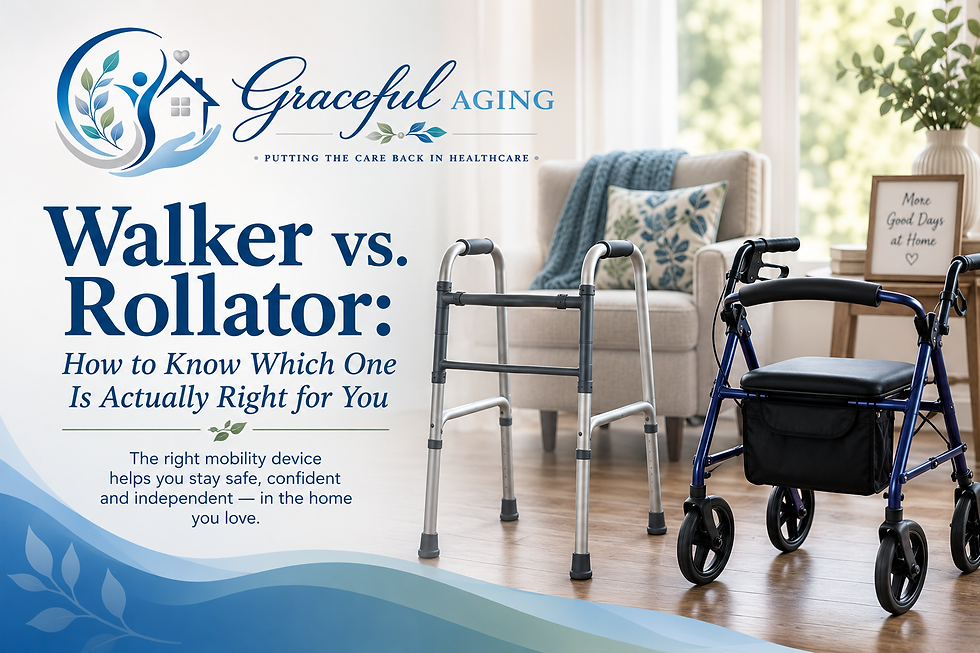
A standard walker provides the greatest amount of stability because all four legs remain firmly on the ground until the walker is lifted forward. This makes it an excellent option for individuals who require the highest level of support while walking. It is commonly recommended after surgery, following a fall, or for those experiencing significant weakness or balance impairments. If you find yourself placing a substantial amount of weight through your arms, a standard walker offers the stability needed to move safely during recovery. Although it requires lifting the walker with each step and may feel slower than other options, that slower pace often improves safety by encouraging controlled movement and reducing the risk of falls. When maximum stability is the priority, a standard walker is often the safest choice.
When a Front-Wheeled Walker Makes the Most Sense
A front-wheeled walker, which has two small wheels on the front legs, provides an excellent balance between stability and ease of movement. Because the front wheels roll forward, the walker glides more smoothly and does not need to be completely lifted with every step. This makes it a great option for individuals who still require significant support but have enough strength and balance to safely control the walker while walking. It is commonly recommended after surgery, following a fall, or for those with weakness, decreased endurance, or mild to moderate balance deficits. A front-wheeled walker promotes a more natural walking pattern, reduces the effort required to advance the walker, and helps conserve energy while continuing to provide excellent stability. While it is easier to maneuver than a standard walker, it still offers more support than a rollator and is often the preferred choice for individuals who need stability but are not yet ready for a four-wheeled walker.
When a Rollator May Be the Better Choice
A rollator is a walker with four wheels, hand brakes, and a built-in seat that is designed for individuals who need less physical support but benefit from assistance with balance, endurance, or longer walking distances.
Unlike a standard or front-wheeled walker, a rollator rolls continuously as you walk, allowing for the most natural and efficient gait pattern. It is often recommended for individuals who can walk independently but become fatigued with prolonged activity or appreciate having occasional support during community mobility. The built-in seat allows you to stop and rest whenever needed, making it easier to shop for groceries, attend church, visit the senior center, or enjoy a walk through the neighborhood without worrying about fatigue.
Although a rollator provides greater convenience and promotes independence, it is not automatically the safest option for everyone. Because it rolls freely, it requires adequate balance, coordination, judgment, and hand strength to safely control the brakes and prevent the walker from moving faster than you do. Before sitting on the built-in seat, always engage both hand brakes and verify that they are fully locked. It is important to remember that only the two rear wheels—located directly below the handles—lock into place. The two front wheels continue to swivel and do not lock, so the rollator can still shift if it is positioned on uneven ground or if weight is applied unevenly. Always make sure the rollator is on a level, stable surface before sitting, back up until you feel the seat against the back of your legs, and lower yourself slowly while keeping both hands on the handles for support. Never attempt to sit while the rollator is still moving or use the seat on a slope or incline. For individuals with significant balance deficits, poor coordination, or those who require substantial weight-bearing support through their arms, a standard or front-wheeled walker is often the safer choice. Choosing the right walker should always be based on your individual strength, balance, endurance, and recommendations from your physician or physical therapist.
The Most Overlooked Part of Mobility Equipment
Here's something almost nobody talks about.
Even if you have the correct walker... It may still be adjusted incorrectly.
This is one of the most common problems I see in patients' homes.
A walker that's too low forces you to hunch forward. A walker that's too high causes your shoulders to elevate unnaturally and reduces stability.
Over time, poor walker height can lead to:
Back, neck, and shoulder discomfort
Poor spinal alignment and posture
Increased strain on the wrists and hands
Muscle fatigue and decreased endurance
Reduced balance and less confidence with walking
Greater risk of trips and falls
Fortunately, checking the height takes less than a minute.
Stand naturally with your arms relaxed at your sides. The walker handles should line up with the crease of your wrists. When you hold the handles, your elbows should have a slight bend of about 15–30 degrees.
That's it.
A simple adjustment can improve your posture, reduce strain on your body, make walking more comfortable, and significantly increase your safety.
Don't Forget to Check the Equipment Itself
Mobility equipment experiences wear and tear just like anything else.
I encourage families to occasionally inspect walkers and rollators the same way they would inspect the tires on a car.
Take a close look.
Are the rubber tips worn smooth?
Have the tennis balls become flattened or the metal town through?
Are the hand grips cracked?
Do the wheels roll smoothly?
Do the brakes engage properly?
Small problems are easy to overlook until they become big problems.
Replacing worn parts is inexpensive and can significantly improve safety.
If You're Helping a Parent
One situation I see frequently is this:
A parent comes home from the hospital with a standard rolling walker.
Six months later they're stronger, walking farther, and feeling more confident.
But they're still using the exact same equipment because nobody ever reassessed what they actually need.
Sometimes they've outgrown that walker and would move much more naturally with a rollator.
Other times the opposite happens.
Someone purchases a rollator because it looks easier, even though they still need the full stability of a standard rolling walker.
Neither situation is ideal.
Mobility needs change.
Equipment should change with them.
That's one reason periodic reassessment is so valuable.
There Is Nothing Embarrassing About Using the Right Tool
I'd like to speak directly to anyone who feels hesitant about using mobility equipment.
There is absolutely nothing embarrassing about using a walker.
Or a rollator.
They're tools.
The same way glasses help us see.
The same way hearing aids help us hear.
Mobility equipment helps us move safely.
The goal isn't simply walking.
The goal is continuing to attend family gatherings.
Going to church.
Shopping independently.
Walking through your own home with confidence.
Living life on your own terms.
That's what mobility equipment protects.
Ask Yourself These Questions
If you're unsure whether your current mobility device is the right fit, consider these questions:
Does it improve your balance and confidence?
Does it feel natural to walk with?
Are you pushing it with your arms straight out in front of you, like you're pushing a shopping cart?
Are you putting too much—or too little—weight through your arms?
Is it adjusted to the correct height?
Are the brakes, wheels, and tips in good working condition?
Has your strength, balance, or walking ability changed since you first started using it?
If any of those questions make you pause, it may be time to have your equipment reassessed.
Sometimes a small adjustment—or a different mobility device entirely—can make an immediate difference in both safety and confidence.
Still Have Questions? Let's Talk.
Choosing the right mobility equipment isn't always straightforward, and every person's needs are different.
If you're unsure whether you—or someone you love—is using the right walker or rollator, I'd be happy to help.
Book a free 20-minute phone consultation with me, and we'll talk through your situation, answer your questions, and discuss practical recommendations based on your goals and mobility needs.
Sara Sparks, PT, DPT
Founder & Licensed Physical Therapist - Graceful Aging
📞 Phone: (210) 526-0516📧 Email: sara@gracefulagingathome.com🌐 Website: gracefulagingathome.com
→ Schedule Your Free 20-Minute Consultation
Helping San Antonio seniors stay safe, independent, and confident in the homes they love.
Comments