

The Room In Your Parent's Home That Scares Me Most
It's not the stairs. Most people are surprised.
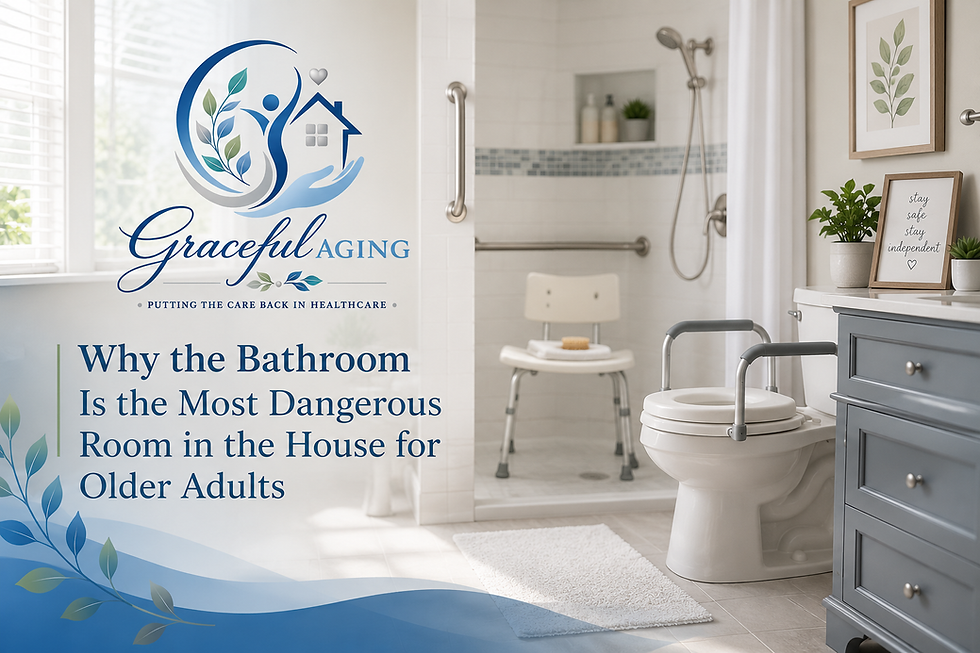
Why the Bathroom Is the Most Dangerous Room in the House for Older Adults
When people think about falls at home, most imagine someone tumbling down a staircase.
It's a reasonable assumption.
Stairs look dangerous.
Bathrooms don't.
But after years of working with older adults in their homes, I can tell you something that surprises almost every family I meet:
The bathroom is consistently one of the highest-risk rooms in the home for serious falls.
Think about everything that happens there.
You step onto wet floors. You climb over the edge of a bathtub. You stand on one leg to dry off. You bend down to pick something up.
You get up from one of the lowest seats in your house.
Many people also rush to the bathroom in the middle of the night because medications make them urinate more frequently or because they suddenly need to have a bowel movement. They're tired, it's dark, and they're often moving too quickly.
You do all of this in a small room with hard tile floors and sharp countertops.
It's the perfect environment for a fall.
The encouraging news?
Many bathroom falls are preventable with a few thoughtful changes that are often inexpensive and can be completed in a single afternoon.
Why the Bathroom Becomes More Challenging With Age
Growing older doesn't automatically mean someone becomes unsafe.
But it does mean our bodies naturally change.
Most people experience gradual changes in:
Balance
Muscle strength
Flexibility
Vision
Reaction time
Joint mobility
These changes usually happen so slowly that we hardly notice them.
Until one day...
A wet floor is just a little too slippery.
The bathtub feels just a little higher.
Standing up from the toilet takes just a little more effort... or maybe you've found yourself "stuck" on the toilet, needing to rock a few times or push with your hands to stand.
Those "little" changes add up.
Unfortunately, the bathroom gives us very little room for error.
Unlike falling onto carpet in a living room, a fall in the bathroom often involves tile floors, porcelain fixtures, countertops, or glass shower doors.
Even what seems like a minor slip can result in:
Hip fractures
Wrist fractures
Head injuries
Hospitalization
A significant loss of confidence
And something many people don't talk about—a fear of falling. Ironically, that fear itself can actually increase your risk of falling. When we're afraid, we tend to take shorter, hesitant steps, avoid movement, lose strength and balance, and become less confident. Before long, the fear creates the very problem we were trying to avoid. .
Many older adults tell me the hardest part wasn't the injury.
It was the fear that came afterward.
Prevention Is Always Easier Than Recovery
One of the biggest misconceptions I hear is:
"We'll make changes if Mom falls."
I understand why people think that way.
But waiting for a fall is a little like waiting for a car accident before putting on your seatbelt.
The goal isn't to react.
The goal is to prevent.
Many of the safest homes I visit aren't owned by people who have already fallen.
They're owned by people who decided to prepare before something happened.
Area 1: The Shower or Bathtub
If I could improve only one part of a bathroom, this would probably be it.
Getting into and out of the shower requires nearly every balance skill we have.
You have to:
Shift your weight.
Lift one leg.
Step over an obstacle.
Land on a wet surface.
Turn your body.
Often do all of this while holding a towel.
That's asking a lot from anyone.
Especially someone recovering from surgery or living with arthritis, weakness, or balance problems.
Ask yourself these questions:
Is there something sturdy to hold onto?
Does the floor become slippery when wet?
Is stepping over the tub becoming more difficult?
Would someone feel confident doing this if they were tired?
If any answer gives you pause, it's worth taking seriously.
Safety Improvements That Can Make a Big Difference
Many families are surprised to learn they don't need to remodel the bathroom.
Often, a few well-chosen additions make a tremendous difference.
These include:
Professionally installed grab bars
A shower chair or transfer bench
A handheld showerhead
Non-slip shower flooring
Easy-to-reach soap and shampoo
These aren't signs of giving up.
They're tools that help people continue bathing independently.
Area 2: The Bathroom Floor
One of the most common hazards I see isn't the floor itself.
It's what's sitting on it.
Decorative bath rugs.
They're soft.
They're attractive.
They're also responsible for many unnecessary trips and slips.
Loose rugs can:
Slide unexpectedly
Curl along the edges
Catch the toes of a shoe
Catch a walker
Catch a cane
Move while someone is turning
Sometimes removing one rug immediately makes the room significantly safer.
Instead, consider:
Rubber-backed non-slip mats
Textured anti-slip strips
Keeping floors dry after showers
Keeping walkways completely clear
Simple often wins.
Area 3: The Toilet
Standing up from a toilet may not seem difficult.
Until it is.
Most toilets are lower than dining chairs or couches.
That means standing requires more:
Leg strength
Hip strength
Balance
Coordination
If someone begins rocking several times before standing...
Pulling on the vanity...
Pushing off unstable surfaces...
Or needing assistance...
Those are important signs.
Fortunately, several simple solutions exist.
Helpful Options
Depending on the person's needs, these may include:
Raised toilet seats
Toilet safety frames
Grab bars beside the toilet
Higher comfort-height toilets
These devices reduce effort while making transfers much safer.
Don't Forget Nighttime
Many bathroom falls happen during the night.
Why?
Because people are:
Half asleep.
Walking in the dark.
Moving quickly.
Not wearing supportive shoes.
Don't want to have an accident on themselves.
A few inexpensive improvements can help enormously:
Motion-activated night lights
Clear pathways
Shoes or slippers with non-slip soles
Easy access to eyeglasses
Removing clutter between the bed and bathroom
Sometimes one small light prevents one life-changing fall.
A Five-Minute Bathroom Safety Check
Walk into your bathroom today.
Stand quietly for a minute.
Then ask yourself:
✅ Is there something sturdy to hold onto when getting in and out of the shower?
✅ Could any rugs slide or bunch up?
✅ Is the floor dry and free of clutter?
✅ Are towels, soap, and toilet paper within easy reach?
✅ Would stepping into the tub or shower be difficult if I were tired?
✅ Is getting on and off the toilet becoming harder?
✅ If I had to rush to the bathroom in the middle of the night, would I have enough light to see where I'm going?
✅ Would I feel safe using this bathroom if I were half asleep?
If even one answer concerns you...
Don't ignore it.
That's exactly how accidents are prevented.
Small Changes Protect Independence
Sometimes families worry that adding grab bars or a shower chair means admitting someone is getting older.
I see it differently.
Those changes aren't about limiting independence.
They're about protecting it.
The goal isn't simply preventing falls.
The goal is preserving confidence.
Helping someone continue living in the home they love.
Maintaining dignity.
Keeping routines intact.
That's what home safety is really about.
Remember This
Most bathroom falls don't happen because someone was careless.
They happen because the environment quietly became more challenging than the person realized.
The good news is that the environment is something we can change.
At Graceful Aging, I often tell families that the safest homes aren't the ones with the most expensive renovations—they're the ones where someone took the time to notice small risks before they became big problems.
Sometimes one grab bar.
Sometimes removing one rug.
Sometimes simply improving the lighting.
Small changes today can prevent life-changing injuries tomorrow—and that's one of the greatest gifts we can give ourselves or the people we love.
Still Have Questions? Let's Talk.
Every home—and every family—is different. If you're wondering whether your home is as safe as it could be, or you're trying to help a parent stay independent, I'd be happy to help.
Book a free 20-minute phone consultation with me, and we'll talk through your specific situation. Whether you have questions about fall prevention, mobility equipment, aging in place, or recovering after a hospital stay, you'll receive practical, evidence-based recommendations with no pressure and no obligation.
Sara Sparks, PT, DPT
Founder & Licensed Physical Therapist
Graceful Aging
📞 Phone: (210) 526-0516📧 Email: sara@gracefulagingathome.com🌐 Website: gracefulagingathome.com
Ready to get started?
Helping San Antonio seniors stay safe, independent, and confident in the homes they love.
Comments