

Five Minutes a Day That Could Change Everything: Three Simple Exercises to Improve Balance and Help Prevent Falls
By Sara Sparks, PT, DPT | Graceful Aging
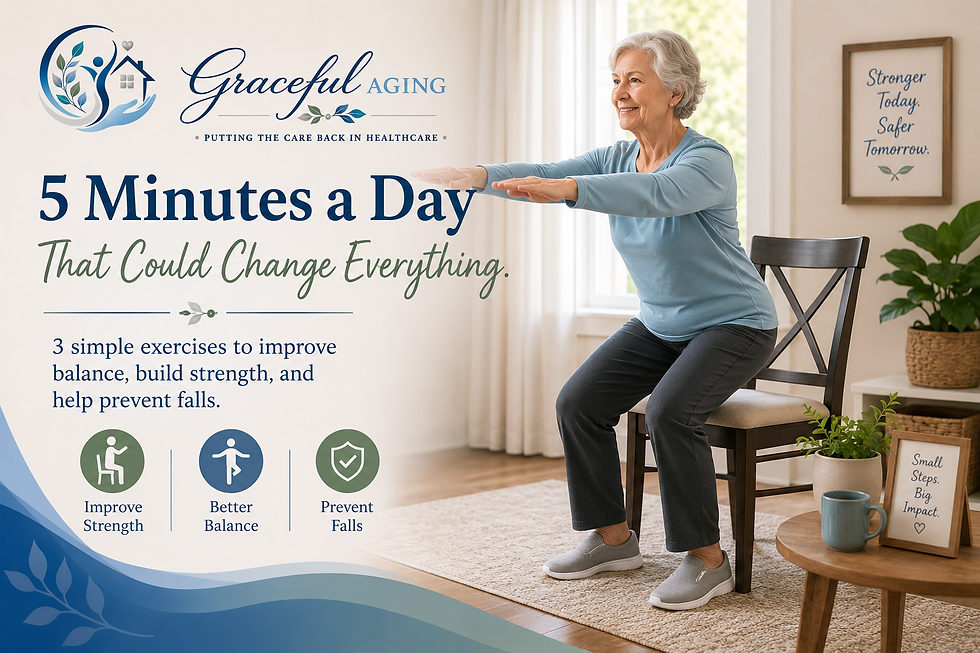
If I could prescribe just one habit that would help most older adults stay independent longer, it wouldn't be an expensive piece of equipment or a complicated exercise program.
It would be this:
Move Your Body... Even When You're Achy
Move your body for five intentional minutes every day.
That may sound almost too simple.
But after years of working with older adults in hospitals, rehabilitation facilities, and people's homes, I've learned something important.
Balance isn't something you either have or you don't.
It's something you maintain.
One of the biggest misconceptions I hear is, "I'm hurting, so I should just stay still."
While there are certainly times when rest is appropriate, many everyday aches and stiffness actually happen because we're moving less. When we sit for long periods, our joints become stiff, our muscles tighten, and our bodies become deconditioned. Then, when we finally get up, everything feels sore and achy.
The right kind of movement helps.
A short walk.
Gentle stretching.
Standing up and sitting down a few times.
Walking to the mailbox.
Even five intentional minutes each day can help reduce stiffness, improve circulation, maintain strength, and support better balance.
Motion is often part of the medicine.
The goal isn't to push through severe pain—it's to keep your body moving in a safe, consistent way.
Your future self will thank you.
Balance is a skill.
Like any skill, it improves when you practice it and gradually declines when you stop.
The encouraging news is that you don't need a gym membership, fancy equipment, or an hour-long workout to make meaningful improvements.
You simply need consistency.
Five minutes.
A sturdy chair.
And the willingness to begin.
It's Never Too Late to Get Stronger
Before I show you the exercises I recommend most often, I want to speak directly to anyone who's hesitant.
Maybe you've had a fall.
Maybe you've had surgery.
Maybe walking feels harder than it used to.
Maybe you've convinced yourself you're simply "too old" for exercise.
I want you to know something.
You are not too old.
I've worked with people in their seventies, eighties, and even nineties who improved their strength, confidence, and balance through simple daily movement.
Not because they pushed themselves to exhaustion.
Not because they exercised for hours.
Because they showed up.
Every day.
Five minutes at a time.
Small improvements add up much faster than most people realize.
Why Balance Matters More Than You Think
When most people think about preventing falls, they picture grab bars or walkers.
Those things absolutely matter.
But they aren't the whole story.
Your body is constantly making tiny adjustments every second you stand or walk.
Your legs provide strength.
Your ankles react to uneven surfaces.
Your muscles help you recover when you stumble.
Your brain coordinates everything together.
The stronger and more practiced those systems become, the more confident and stable you feel.
That's why balance training isn't just about preventing falls.
It's about protecting your independence.
Exercise #1: Chair - sit to stands
If I could recommend only one exercise for most older adults, this might be it.
It looks simple.
But don't let that fool you.
The ability to stand up from a chair safely is one of the strongest indicators of independence later in life.
Think about how often you stand up during the day.
Getting out of bed.
Standing from the dining table.
Leaving the couch.
Getting off the toilet.
Every one of those movements requires leg strength.
To perform a chair sit-to-stand, sit in a sturdy chair with armrests if needed. Scoot forward to the edge of the seat and place both feet flat on the floor about hip-width apart.
Cross your arms over your chest or hold them comfortably in front of you. Slowly stand up without using your hands if you're able. If needed, use the armrests to assist. Then slowly lower yourself back into the chair with control.
That counts as one repetition.
If you're just getting started, aim for five repetitions. Over time, gradually build toward fifteen.
Don't rush. The slow, controlled movement is what helps build strength.
Every repetition helps strengthen the muscles you'll rely on every day to remain independent.
Exercise #2: Heel and Toe Raises
Most people don't think much about their ankles.
Until they need them.
When you begin to lose your balance, your ankles are often your body's first line of defense.
Strong calf muscles and ankles help you recover before a stumble becomes a fall.
To perform heel raises, stand at the kitchen sink and lightly hold the countertop with one or both hands for stability, as this provides the best stability. Lightly rest your hands on the support, then slowly lift your heels off the ground so you're standing on your toes. Hold for two seconds, then slowly lower your heels back to the floor.
Most people think about heel raises but forget the opposite movement. After your heel raises, gently rock back onto your heels and lift your toes toward the ceiling. This strengthens the muscles in the front of your lower leg, improves ankle mobility, helps with foot clearance during walking, and can reduce the risk of tripping.
Start with ten repetitions of each exercise and gradually work toward twenty.
Besides improving balance, these exercises also encourage circulation and can help reduce the stiffness and swelling many older adults notice after spending long periods sitting.
Exercise #3: Single-Leg Balance
If balance itself is your goal, this is one of my favorite exercises.
Stand at the kitchen sink and lightly hold the countertop with one or both hands for stability.
Lift one foot just slightly off the floor while balancing on the other leg.
Hold for about ten seconds if you can, then switch sides.
If ten seconds feels impossible today, that's okay.
Hold for three.
Or five.
Whatever you can safely manage.
Over time, work toward holding thirty seconds on each leg.
This exercise does more than strengthen muscles.
It teaches your body how to react to small changes in balance before they become larger problems.
In fact, difficulty standing on one leg—even for just a few seconds—can be an important sign that balance deserves more attention.
The good news is that balance improves with practice.
Every second you spend working on it is an investment in your future mobility.
Consistency Beats Intensity
One of the biggest mistakes people make is believing they need a difficult workout to see results.
That's simply not true.
I'd much rather see someone perform these three exercises for five minutes every morning than spend one hour exercising every few weeks.
Consistency is what changes your body.
Think of it like brushing your teeth.
The benefit doesn't come from brushing for an hour once a month.
It comes from doing a little bit every day.
Your balance works the same way.
Five minutes before breakfast.
Every day.
That's enough to begin seeing meaningful improvements over the next four to six weeks.
If You're Helping a Parent
If you're reading this because you're concerned about someone you love, here's my advice.
Don't just send them the exercises.
Do them together.
Some of my most successful clients aren't successful because they found a magical exercise program.
They're successful because someone they love joined them.
Exercise becomes less intimidating when it feels like spending time together instead of being told what to do.
Five minutes can easily become part of your visit.
Stand together.
Count the repetitions together.
Celebrate progress together.
Those shared moments often become just as valuable as the exercises themselves.
Progress Doesn't Have to Be Dramatic
Many people expect immediate changes.
That's not how strength works.
Progress often looks like:
Getting out of a chair a little easier.
Feeling steadier while walking.
Climbing stairs with more confidence.
Walking through the grocery store without needing as many breaks.
Standing at the kitchen counter a little longer.
Those are victories.
And they often begin with just a few minutes of movement each day.
The Hardest Part Is Starting
If you've made it this far, I have one request.
Don't wait until tomorrow.
Stand up.
Walk over to your kitchen sink or find a sturdy chair.
Do five chair stands.
That's it.
You don't have to finish all three exercises today.
You don't have to be perfect.
You just have to begin.
The hardest step is almost always the first one.
A Few Questions to Ask Yourself
As you think about your own balance—or the balance of someone you love—consider these questions:
Do you feel less steady than you did a year ago?
Have you stopped doing activities because you're afraid of falling?
Is it becoming harder to stand up from a chair without using your hands?
Do your legs tire more quickly than they used to?
Would spending five minutes each day be worth it if it helped you stay independent longer?
If you answered "yes" to any of those questions, there's no better time to start than today.
Small, consistent actions have a remarkable way of changing the future.
Still Have Questions? Let's Talk.
Everyone's balance, strength, and mobility are different. The best exercise program is one that's built around your current abilities and your personal goals.
If you'd like guidance creating a safe, effective movement plan for yourself or someone you love, I'd be happy to help.
Book a free 20-minute phone consultation with me, and we'll discuss your situation, answer your questions, and recommend practical next steps to help you move with greater confidence.
Sara Sparks, PT, DPT
Founder & Licensed Physical Therapist - Graceful Aging
📞 Phone: (210) 526-0516📧 Email: sara@gracefulagingathome.com🌐 Website: gracefulagingathome.com
→ Schedule Your Free 20-Minute Consultation
Helping San Antonio seniors stay safe, active, and independent in the homes they love.
Comments